Before the First Cable: Scoping Temporary Services for a Fit-Out That Stays Live
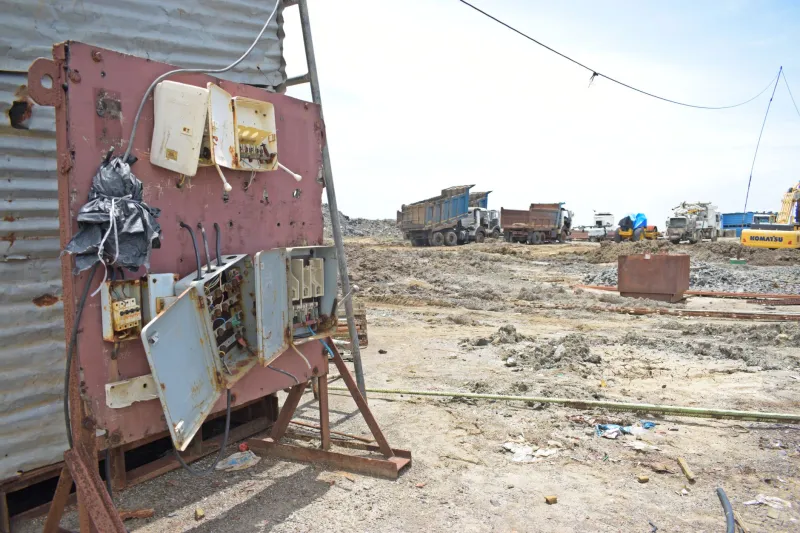
Temporary power and water are often treated as site conveniences until a distribution board trips, a standpipe runs dry or a hire company asks where the meter should have been fitted. On a UK fit-out, these services are programme infrastructure. They support strip-out, temporary lighting, welfare, drying, commissioning and the gradual transfer to permanent supplies. If they are scoped late, the consequences are rarely confined to the site cabin; they reach into the programme, the budget and the relationship with the landlord.
Begin with the load, not the lead
The first useful document is not a hire order. It is a temporary services schedule that sets out what the project expects to draw, where it expects to draw it from and who is responsible for each connection. The schedule should list the likely loads by trade and by phase: temporary lighting, small tools, welfare facilities, dehumidifiers, charging points, commissioning equipment and any specialist plant. It should also record the voltage and phase requirements, because a simple count of socket outlets says very little about capacity.
Diversity needs to be considered honestly. A fit-out that runs several trades at once may not draw every load simultaneously, but neither should the distribution board be designed around a best-case coincidence. The temporary supply should be sized with a sensible allowance for future phases and for the fact that commissioning often arrives before the permanent supply is energised. On UK sites, 110V centre-tapped earth arrangements remain common for construction use, while 230V supplies may be needed for welfare, drying or specialist equipment. The design should reflect BS 7671 principles and the project's own electrical safety arrangements, not simply the nearest available lead.
Draw the isolation boundaries
Many temporary supply problems begin with an unclear boundary. The landlord may provide a supply, the principal contractor may distribute it, and several subcontractors may each believe they are responsible for isolation. Before strip-out, the project should agree a single-line diagram showing the origin, distribution boards, protective devices, cable routes and the points at which responsibility changes hands. Those boundaries should be labelled physically as well as documented.
Isolation and lock-off arrangements need to be explicit. Who can isolate the temporary board? Who can reset a protective device? What permit is required before work on or near the supply? Temporary boards should not become informal charging points for every trade, and existing landlord sockets should not be borrowed without written agreement. A clear boundary is not bureaucracy; it prevents the familiar sequence in which a tripped board is reset by someone who does not know what caused the trip, and the fault is repeated later in the day.
Metering, hire terms and the cost of improvisation
Unmetered supplies are a quiet source of dispute. Where temporary power or water is taken from an existing landlord supply, the project should agree meter readings at the start and end of the connection, together with the basis for recharge. Where sub-metering is practicable, it gives the fit-out team a clearer view of consumption and helps to avoid assumptions about who used what. The same discipline applies to water: a standpipe connection may appear straightforward, but the water undertaker, landlord or managing agent may each have different requirements for metering, backflow prevention and access.
Hire costs also deserve early attention. Last-minute hire often carries a premium, and the cheapest weekly rate may not be the lowest cost once delivery, collection, fuel, standing charges and extended hire are included. The project should confirm the hire period, the off-hire notice required, the condition of the equipment on delivery and the arrangements for swaps or repairs. Temporary services should be ordered against the programme, not against the day someone notices that the cabin is dark.
Water, waste and drainage
Temporary water is not only a welfare matter. It may be needed for dust suppression, cleaning, testing and commissioning. The project should confirm flow and pressure at the proposed connection point, the route of the temporary supply, protection from damage and the arrangements for backflow prevention. Where temporary drainage is required, the discharge route should be agreed before any connection is made. Silty water, washout and trade effluent should not be directed to surface water drains or to drainage that cannot accept them.
Welfare connections need the same thought. A standpipe that serves a cabin but cannot serve the cleaning regime will be supplemented by informal arrangements, and those arrangements are usually less safe. If temporary toilets or washing facilities are used, the discharge and maintenance responsibilities should be written into the temporary services schedule. The objective is not to over-engineer the installation; it is to make sure the simple questions have answers before they become urgent.
A checklist before strip-out
- Confirm the temporary services schedule, including likely loads, phases and future allowances.
- Agree the origin of supply, distribution routes, protective devices and isolation boundaries.
- Record who may isolate, reset or alter the temporary installation.
- Confirm voltage arrangements, cable protection and suitability for the site environment.
- Agree meter readings, recharge basis and sub-metering where practicable.
- Confirm water connection point, flow, pressure, backflow prevention and metering.
- Agree drainage and discharge routes, including restrictions on silty or trade effluent.
- Check hire terms, delivery dates, off-hire notice and responsibility for fuel or standing charges.
- Label boards and cables clearly, and keep the single-line diagram available on site.
- Nominate contacts for the landlord, supplier, water undertaker and site team.
- Provide a contingency for failure, including temporary lighting and welfare cover.
Temporary services are not temporary decisions. They shape the first days of strip-out, the middle of the programme and the final push towards commissioning. A clear schedule, agreed boundaries and realistic metering turn temporary power and water into quiet infrastructure. Left until the last moment, they become the reason the programme stops while someone searches for a cable, a key or a meter reading.