Setting Out with Evidence: Dimensional Control in the First Two Days of a Fit-Out
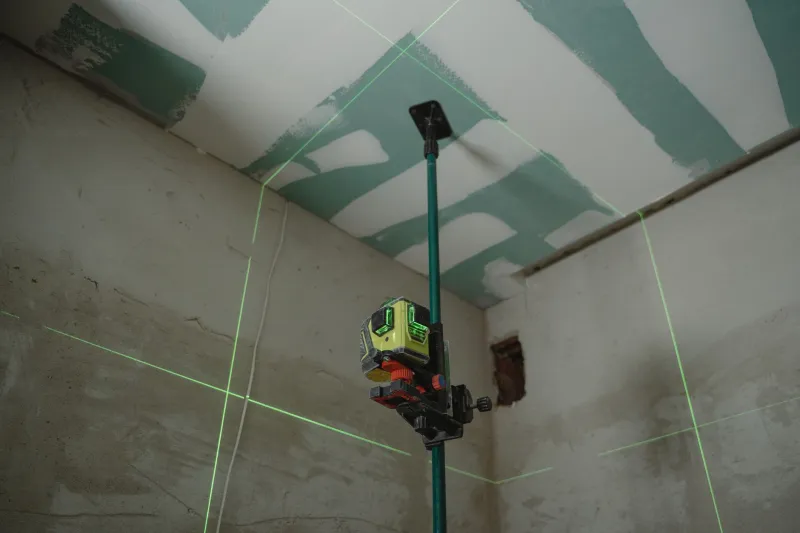
A fit-out rarely announces itself as a dimensional problem. It emerges later: a partition that leaves too little clearance for a riser, a ceiling grid that fights the structure, a door set that arrives at an opening that is not quite where the drawing said it would be. By then, several trades have fixed work to a line that should have been checked before it was marked. The first 48 hours are therefore not a mobilisation formality. They are a control point.
The first two days decide what later trades chase
On a live-site refurbishment, the building is rarely as tidy as the drawing. Existing walls may be out of plumb, floor slabs may vary in level, and previous alterations may never have been recorded. If the setting-out team treats the architect's existing-plan drawing as a survey, the fit-out begins with an assumption. That assumption is then multiplied by every trade that follows.
For PR Installations, setting out is a verification exercise first and a marking exercise second. The objective is not to draw the grid quickly. It is to establish a controlled, recorded basis from which partitions, ceilings, joinery, mechanical containment and finishes can be installed without reopening the same argument.
Reconcile the survey before the string line
Before any permanent line is marked, the measured survey should be compared with the construction drawings at the critical locations. This means checking structural openings, slab levels, ceiling voids, service risers, column positions and the relationship between the building grid and the proposed fit-out grid. Where the building and the drawing disagree, the disagreement should be recorded and resolved through the appropriate request for information rather than absorbed silently on site.
A practical check is to establish a primary datum and a secondary control line, then verify them against more than one reference point. A single laser reading can be correct in isolation but misleading if the reference point itself has moved. Cross-checking against structure, existing datum marks and survey control reduces the risk of building the entire fit-out from a local anomaly.
Tolerance stacking turns small allowances into large problems
Every trade works to a tolerance. Partitions have one, ceiling grids have another, mechanical services have their own, and joinery and finishes add further variation. The danger is not any single tolerance. It is tolerance stacking: the cumulative effect of several small allowances all moving in the same direction.
Setting out should allocate tolerance deliberately. If a partition is set out to its nominal position with no allowance for the services that must pass behind it, the next trade inherits a problem. If a ceiling height is marked without considering the structural soffit and the deepest service zone, the ceiling grid may be installed to a line that cannot accommodate the services above it. The setting-out record should show not only where the line is, but which tolerances have been allowed and where the critical clearances sit.
On complex fit-outs, it is often sensible to set out zone by zone rather than relying on one global grid. A local origin can reduce the distance over which error accumulates, provided each local origin is tied back to the primary control. The important point is that the strategy is documented and understood by all trades, not left to individual interpretation.
Hold points: where work must wait for a signature
A hold point is a point in the programme where work should not proceed until a check has been completed and recorded. In setting out, hold points are particularly valuable before partitions are fixed, before first-fix containment is installed, and before ceiling grids are suspended. Once those elements are fixed, correction becomes disruptive and expensive.
The hold point should have a named checker, a defined scope and a clear record. It is not enough for the site lead to look at the line and say it appears correct. The check should confirm the datum, the grid, the critical dimensions and the relationship to the survey. If the check reveals a discrepancy, the hold point remains open until the discrepancy is resolved. Program pressure is not a resolution.
Laser setting-out records: the evidence trail
Laser levels and total stations are now routine on UK fit-out sites, but the record they produce is often thin. A line marked in chalk or spray paint is not a record. It is a temporary instruction that can be erased, painted over or misinterpreted.
The setting-out record should capture the equipment used, its calibration status, the control points, the datum, the lines established and the person who checked them. Annotated photographs are useful, particularly where lines pass through several rooms or where existing structure interrupts the grid. The record should be intelligible to someone who was not on site when the line was set, because that is precisely the person who may need to rely on it later.
The paperwork that proves a line was checked before it was fixed
A credible setting-out pack might include a setting-out sheet, a survey deviation register, hold-point sign-offs, the request-for-information log, calibration certificates and marked-up drawings showing the verified positions. These documents do not exist to satisfy bureaucracy. They provide the evidence that a line was checked before it was fixed, which is the difference between a controlled fit-out and a sequence of corrections.
The pack also supports handover. If a future alteration requires a penetration or a partition to be moved, the setting-out record shows what was built and why. That is valuable in any live-site refurbishment, where the next project may begin before the current one has faded from memory.
A practical sequence for the first 48 hours
The first day should establish control: confirm the datum, verify the primary and secondary reference points, and reconcile the survey at the critical locations. The second day should convert that control into marked lines, with each line checked against the record before any trade fixes to it. The sequence is not glamorous, but it is the point at which the fit-out either gains a reliable dimensional basis or begins to chase the building.
Setting out with evidence costs time at the front end. It saves considerably more time later, when every trade is working from the same verified line rather than discovering, one installation at a time, that the drawing and the building were never quite reconciled.